
Editor's note: A version of this essay won the Student Paper Award at the 2026 Science Fiction Research Association (SFRA) Conference.
“Each child is a question I will never solve, only walk beside.”
- Aleah Black
One of the enduring hallmarks of Octavia Butler’s work is her profoundly complex explorations of both individual and communal genealogy and lineage. Her best-selling novel Kindred (1979), written early in her career, explores a Black woman’s troubled relationship to an enslaver and white supremacist who is also one of her ancestors; her final novel, Fledgling (2005), follows a vampire who must rebuild a community and family after a horrific attack. Her Lilith’s Brood trilogy—Dawn (1987), Adulthood Rites (1988), and Imago (1989)—specifically examines generational change and what it means to parent children who are much different than you are.

A Library of America omnibus edition of Lilith’s Brood (also known as the Xenogenesis Trilogy)
Set two and a half centuries after a devastating nuclear war, Lilith’s Brood tells the story of humanity’s remnants, saved by the Oankali for the purpose of interbreeding and repopulating Earth. The first Lilith’s Brood novel, Dawn, centers Lilith. Taken by the Oankali, she slowly acclimates to her new life aboard the Oankali ship as she learns of their plans to repopulate Earth. The second book in the series, Adulthood Rites, sees Lilith living on Earth with a hybrid family, including adult humans and Oankali, as well as hybrid children, referred to as constructs. Adulthood Rites primarily focuses on Akin, the first male construct born to a human mother (Lilith). Akin’s gender presents interpretive difficulties for the mixed community of human and Oankali adults who are raising him.1 Even with five parents across two species (human male and female parents, Oankali male and female parents, and an Oankali ooloi parent), his parents do not have a model for Akin’s development. They must figure out the best way to raise him without assuming he will behave exactly like a human or Oankali man, since he is neither.
Although he is initially treated in a way that attempts to bring his experience of the world in line with a normative human childhood, over the course of Adulthood Rites, Akin advocates for—and is eventually given—increasing autonomy in his own development. I argue that the childhood that Butler depicts can serve as a blueprint for how we might better love and respect trans children.
Trans Children and Reproductive Time
Butler’s hybrid future disrupts familiar timelines of aging and reproduction. In doing so, it opens up liberatory possibilities for a relationship between parents and trans children that isn’t beholden to these normative chronologies. Elizabeth Freeman has coined the term chrononormativity to describe “the use of time to organize individual human bodies toward maximum productivity” (Freeman 3). The examples of chrononormativity that Freeman provides (schedules, calendars, wage employment, bed times, meal times, etc.) are all noteworthy in their day-to-day regularity. These temporal features are so deeply baked into our daily lives that they constitute “a mode of implantation, a technique by which institutional forces come to seem like somatic facts” (Freeman 3).

The first edition of Dawn (1987), published by Warner Books
However, other scholars of queer and trans theory have also noted the ways that chrononormativity organizes the overall trajectory of our lives on a larger level. Roughly five years before Freeman coined the term, Jack Halberstam argued that lives are normatively sketched around reproductive time. For Halberstam, the temporality that most usually underscores a desirable, middle class life is linear in nature and is marked by the passing of milestones ultimately directed at having children: “The time of reproduction is ruled by a biological clock for women and by strict bourgeois rules of respectability and scheduling for married couples. Obviously, not all people who have children keep or even are able to keep reproductive time, but many and possibly most people believe that the scheduling of repro-time is natural and desirable” (Halberstam 5). As a chrononormative temporality, reproductive time describes the “proper” life as a strict linear timeline with vitally important milestones (that is, puberty, marriage, and having children). Notably, chrononormativity carries the same kinds of dangers as other forms of assumed normativity: Absent any substantial challenge, the privileging of chrononormativity over experiences of time not geared toward maximum production in a cis-het world at best ignores non-normative temporalities and at worst assaults and invalidates them.
While trans people are certainly not the only group imperiled by the very existence of chrononormativity, its implications for the trans community and trans children specifically are bleak. Steph Berens has argued that chrononormativity creates what she describes as a “cisnormative temporal bind,” most compellingly attaching that bind to the way that the medical establishment frames narratives of transition in terms of illness: the development of Gender Identity Disorder, for example, or the reliance on gender dysphoria to validate trans experience. To cast transness as an illness is, in turn, to construct cisgender identity as healthy.
This framing of transness as an illness also places it within a chrononormative, linear timeline. Berens writes, “Transness is configured as a present phase on a linear transitioning path from a traumatic childhood in the past to the ‘curing’ of a ‘wrong body’ in the future. This imagination clearly separates pasts, presents, and futures, and co-opts transitions as the key to passing from a volatile and ‘sick’ present into a stable, cis-passing, ‘healthy’ future” (Berens 116). The figuring of transness as a stop on a linear timeline from “sick” (trans) to “healthy” (cis) both invalidates the pasts of trans people who have medically transitioned and seeks to erase the presents and futures of those of us who do not want to medically transition and/or are not concerned with passing. In both cases, trans people are assumed not to exist in any real way in the past or present, and they are simply omitted from the future.
Chrononormativity harms trans adults by casting their experiences of time as wrong, harmful, or disordered. For example, it is common among trans people undergoing HRT to refer to the experience as “going through puberty.” This terminology feels right for many trans people, even as it risks portraying them as childish or not as developed to a world that values the linear timeline of chrononormativity, which treats puberty as a one-time, adolescent event. However, chrononormativity can also harm trans children by denying them a personal experience of temporality and removing their autonomy in favor of a chrononormative timeline. Tellingly, such an understanding of trans children conspicuously ignores the possibility that a child may want to transition as an adult, or may value the experience of visible difference or alternative temporality that transitioning after puberty allows. So how do we nurture a sense of queer or trans time in queer and trans children rather than allowing it to be smothered by chrononormativity?
Jules Gill-Peterson offers a simple answer in “How to Bring Your Kids up Trans,” the final chapter of her monograph Histories of the Transgender Child:
Rather than serving as a potential etiology for transgender diagnosis writ large or as living laboratories for harnessing plasticity, trans children need to have access to an enfranchised voice to articulate situated knowledge to which medical practice is held accountable. As simple as it sounds, pediatric trans medicine would be radically transformed by actually asking trans children what they want and truly basing care on that knowledge. (Gill-Peterson 199, emphasis original)
One way that we could potentially nurture the lives of trans children generally is by returning to them the autonomy and self-determination that a chrononormatively ordered life has taken. While Gill-Peterson’s suggestion is relatively simple, applying it to trans temporality carries the persistent difficulty of trying to talk about the past, present, and future all together as one concept rather than discrete locations on the timeline of our lives. Turning to science fiction offers models for dealing with this difficulty, given the genre’s ability to explore differing and alternate temporalities.
From a novel of spontaneous time travel (Kindred), to a series that starts in colonial Africa and ends ten thousand years in our future (Patternist), different temporalities are a persistent theme across Octavia Butler’s work. The Lilith’s Brood trilogy opens with the experience of being unstuck in time. Upon waking on the Oankali ship, the titular Lilith asserts that she is twenty-six. In response, she is told that she has been kept asleep and has only aged in the short times she’s been awakened by the Oankali, “about two years altogether.” When she notes that she “has no sense of being two years older,” her caretaker informs her that she has been modified on the cellular and molecular level and that she will “live much longer than a hundred and thirteen years. And for most of [her] life, [she]’ll be biologically quite young. [Her] children will live longer still” (Butler 24-25). From the outset, it is clear that Lilith’s Brood takes place in a future that will not—indeed, cannot—exist with the chrononormativity of the past, because Lilith cannot map her life experiences neatly onto this extended timeline.
Furthermore, the fact that her children will live even longer prevents Lilith (or any human) from attempting to establish a sense of normative chronology for their children. Just as Lilith was unable to map a past chronology onto her extended lifespan, she will not be able to map her own personal chronology onto her children’s even further extended lifespans. From its outset, Lilith’s Brood demonstrates Gill-Peterson’s insight: If Lilith is to raise children so physically and mentally different than her, she must instead pay attention to what they want and the trajectories that they choose for their lives.
Autonomy and Adulthood Rites
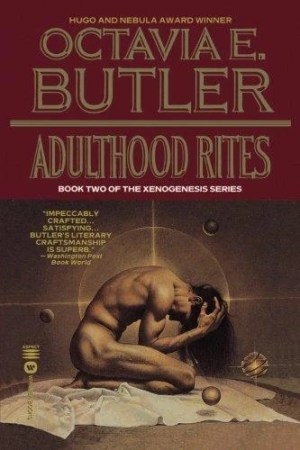
A 1997 edition of Adulthood Rites, published by Warner Books
While this exploration of differing temporalities and experiences of time undergirds all three Lilith’s Brood novels, it is the second novel, Adulthood Rites, that most completely explores what it means to restore autonomy to a child and how that might accomplish healing. In Adulthood Rites, humans and Oankali live together on a restored Earth. Since the Oankali sterilized all humanity, the only way humans can have children is in a mixed human/Oankali family group. Bitter resisters (humans who have chosen to live apart from the Oankali) have taken to stealing construct children who look the most human and attempting to raise them as their own. Appearing entirely human except for his tentacle-like tongue, Akin is stolen by a resister community called Phoenix.
All five of his parents decide to let the resisters keep him for an extended period. This decision is notable because Akin was not consulted about it at all. It is only many months later, after he has been rescued, that his family tells him why they took so long to retrieve him: Akin’s parents decided that he could gain experience and knowledge about his human side from living with the resisters, at the expense of his connection with his construct sibling. His parents effectively chose the most developmentally appropriate (which is to say, human-normative) path for Akin. In this way, Akin has his autonomy stripped from him because his family believes they have a better sense of what he needs to grow up than he does.
Interestingly, as soon as Akin is kidnapped, he begins to behave in a more chrononormative way as a survival strategy. As a construct, Akin is able to speak and adjust his social behavior (e.g. asking for attention rather than simply crying) from almost the moment he is born. This ability, however, marks him as temporally other to the resisters, who would expect a baby to exhibit the behaviors of a baby human. Akin does not reveal himself to his captors for fear that his non-human experience of time and growth may cause them to react violently.
His inability to communicate seems to cause him most distress when he is incapable of expressing his own wants, needs, and abilities. For example, when two of his kidnappers are arguing about who will care for him, one says “Let him piss on you.” Hearing this,
Akin was barely able to stop himself from speaking out in indignation. He had not urinated on anyone for months—not since his family had been able to make him understand that he should not, that he should warn them when he needed to urinate or move his bowels. He would not have urinated even on these men. (Butler 318)
Here, too, we can see some parallels between Akin’s experience and that of some trans children: One of the earliest disconnects between Akin and his captors is not only a misunderstanding of his body (which the captors seem to insist they have strong knowledge of), but the fact that expressing his autonomy would put Akin in such danger that he simply cannot assert his own reality to these men.
More importantly, Akin is regularly seen as a temporal oddity when he acts of his own volition to care for himself. Shortly after he is kidnapped, Akin and his captors are caught in severe rain and are forced to make camp. Akin takes this opportunity to care for himself, since his captors do not seem concerned with him:
Akin went out of the shelter, found a place to relieve himself and another place—a clearing where one of the larger trees had recently fallen—where the rain fell heavily enough for him to wash himself and to catch enough water to satisfy his thirst … when he reentered the shelter, wet and glistening, carrying broad, flat wild banana leaves to sleep on, the men all stared at him. ‘Whatever it is,’ one of them said, ‘it isn’t as Human as we thought. Who knows what it can do? I’ll be glad to get rid of it.’ (Butler 321)
Again, it is neither violence nor visual difference that disgusts and repulses these men, but the fact that Akin does not behave as a child his age should. According to their sense of chrononormativity, a baby should not be able to care for themself at all, much less without any help from adults. However, if they were to value Akin as a person, extend to him a modicum of autonomy, and consult him about his body and needs, they would maybe be less repulsed, and Akin would be better cared for.
Later, when Akin is being cared for by the resister community in Phoenix, we see adults extending that kind of care. Since his strongest Oankali sensory organ is his tongue, Akin regularly puts new plants or materials in his mouth to study them on a cellular level. This behavior greatly worries the humans of Phoenix, who are concerned that Akin will eventually consume something poisonous. After being stopped more than once, Akin finally voices his bodily needs. He says, “I must put things in my mouth to understand them. And I must try to understand them. Not to try would be like having hands and eyes and yet always being tied and blindfolded. It would make me … not sane” (Butler 384). Tellingly, Akin does not just voice his need to understand and therefore put things in his mouth, but he connects it to the human sensory experience of seeing and touching. In doing so, Akin demonstrates that he can exercise his bodily autonomy, even if his body is substantially different from the bodies of his caregivers.
Here, we can see echoes of Gill-Peterson’s insights about bodily plasticity. Gill-Peterson notes that, “Since plasticity is a quality—a capacity to generate and receive imprints in form—and not a visibly discrete ‘part’ of the body, endocrinology called upon the figure of the developing child to serve as a stabilizing metaphor” (Gill-Peterson 35, emphasis original). When Akin’s kidnappers see him, they do not see a person with his own wants and needs, they see potential. Since he is so young, the resisters believe that they can alter Akin’s behaviors to make him more human. To use Gill-Peterson’s terminology, they want to imprint their ideas of what humanity means bodily and psychologically onto Akin. The resisters originally value Akin for his ability to look human, despite the fact that he is not. That valuation leads them to try to normalize Akin’s behavior to accord with their own both physically (not putting things in his mouth) and temporally (insisting that he is incredibly intelligent and way ahead of where he should be developmentally). The resisters are not trying to adjust Akin’s behavior for his benefit developmentally. They see him as the ideal representation of a reproductive future that was taken from them by the Oankali, and are trying to bring him closer in line with that ideal.
Akin’s parents seem to share this desire to harness his perceived plasticity. Akin’s parents—and the Oankali generally—favor leaving him with the resisters, so that he can learn more about his humanity. This motivation may seem noble at first, but it takes on a more troubling dimension when we recall the reason the Oankali saved humanity from nuclear apocalypse in the first place: the Oankali’s project of gene trading and hybridization. They leave Akin with the resisters at least in part because they think it will help them more successfully intermix with the resisters in the future. Akin is consistently treated in a way that strips him of his autonomy by trying to control his temporal development. The resisters want him to be more like a toddler, and his family thinks that he can achieve a certain kind of development by being left with the resisters. This is fundamentally similar to the way that trans children are used for means other than their own. Akin, like trans children, is at first neither loved nor cared for on his terms, but rather according the terms that the adults who care for him are most comfortable with. This is more than just a breach of his autonomy: It causes great harm to Akin and his sibling’s emotional development and attachment to one another.
After he is recovered, however, the relationship between Akin and his family undergoes a significant change. Akin’s family and the whole of the Oankali population extend Akin a massive degree of autonomy after his ordeal. They give him a choice of where he would like to live, what he would like to do, and ultimately go against the ingrained Oankali ideology that says humans must not be allowed to reproduce on their own because of Akin.
This newly-granted autonomy has consequences for more than just Akin. Earlier in the novel, Akin’s parents make choices for him with the understanding that they know what will be best for him as he develops. However, it becomes clear that Akin develops in a way that the Oankali did not expect. According to the Oankali, humanity has evolved to be intelligent and hierarchical, two tendencies which the Oankali insist will always result in the extinction of the species if left alone. The gene-trade that they participate in with humans is intended to remove this “contradiction.” The Oankali use this paternalistic essentialism to justify their treatment of resister humans, who are sterilized. When humans try to discuss the contradiction with the Oankali, they are dismissed out of hand; the Oankali treatment of humanity at large mirrors the stripping of autonomy that Akin endured. Like trans children, neither Akin nor humanity has a way to voice their wants and needs, so they simply go unmet. However, after his family rescues him from his kidnappers, Akin can recognize that treatment for what it is:
Who among the Oankali was speaking for the interests of resister Humans? Who had seriously considered that it might not be enough to let Humans choose either union with the Oankali or sterile lives free of the Oankali? Trade-village Humans said it, but they were so flawed, so genetically contradictory that they were often not listened to … [Akin] was Oankali enough to be listened to by other Oankli and Human enough to know that resister Humans were being treated with cruelty and condescension. (Lilith’s Brood 404)
Once he is given autonomy over his future, Akin decides to become a voice for the resisters. The Oankali eventually acquiesce to Akin’s insistence that the resisters have another option and allow them to live unsterilized lives away from the bulk of the Oankali and constructs on a terraformed Mars. When given autonomy to choose his future, Akin restores the autonomy of the resisters and eases the essentialist oppression that the Oankali are inflicting on them. Here, there are clear parallels to Gill-Peterson’s solution of giving trans children access to an enfranchised voice. Akin and other constructs are able to articulate the feelings and needs of resister humans in a way that sways the Oankali, even as they remain steadfast in their insistence that the contradiction will eventually lead to human extinction.
Trans Futures

The most recent edition of Imago, published by Grand Central Publishing
Butler herself famously used her writing as a way to address what she saw as a lack of people like her in SF literature: “I never bought into my invisibility or non-existence as a Black person. As a female and as an African American, I wrote myself into the world. I wrote myself into the present, the future, and the past” (“Remembering Afrofuturist Octavia Butler”). That connection between Blackness and futurity is one of the concerns of Afrofuturism writ large. Given Afrofuturism’s ability to imagine marginalized subjects in the future, it is perhaps unsurprising that Butler’s work also has the potential to meaningfully address the harms that chrononormativity inflicts on trans children.
Trans people are the future and trans people are in the future are bold assertions of reality and affirmations of trans existence: When we imagine trans people as in the future and building the future, we reaffirm a commitment to protect trans life in the present. This sense of trans futurity is important, but I would like to propose a less chrononormative sense as well. Just as important as the sense that trans people build and exist in our futures (tomorrow, next week, month, year, decade, century), is the sense that trans people exist in the future, right now, today.
Much has been written about Afrofuturism as Black feminist praxis and Butler herself as a Black feminist. Taking the connection between Afrofuturism and Black feminism into consideration, coupling Lilith’s Brood with a text like bell hooks’s All About Love can help us transfer the lessons of Butler’s future to our present. By creating a future where children (regardless of their perceived humanity or normalcy) are allowed to voice their opinions and to have those opinions validated on the same level as adults, Butler demonstrates one of hooks’s key insights. hooks begins All About Love by defining love itself as “the will to extend one’s self for the purpose of nurturing one’s own, or another’s, spiritual growth” (hooks 10). This definition of love matches intensely some of the best scenes of love from Lilith’s Brood. All three novels contain several examples of characters who make sacrifices and endure intense discomfort all in the name of the spiritual growth of other characters. Lilith herself spends most of Dawn conflicted about her part in the Oankali’s colonizing and hybridizing, and distrustful of the Oankali. However, by Adulthood Rites, we see Lilith living in a hybrid Oankali/human family and caring deeply for her children. Putting aside her discomfort and distrust, Lilith extends herself to nurture the growth of her children, even as she understands that they are radically different from her and that she is not capable of understanding their perspectives fully.
Not only do these scenes show us what it may look like to respect the autonomy of others and love them well, but they clearly align Butler’s creative work with hooks’s theoretical insights. When we consider hooks’s definition of love, it becomes painfully clear that often we care for trans children without truly loving them. Like the resisters who think they are saving Akin by pulling things out of his mouth, or the Oankali who insist that the contradiction in humanity means allowing the resisters to reproduce would be a form of cruelty, when we place children on pre-determined paths and invalidate their own experiences of their bodies, minds, and even time itself, we cause substantial harm. To love trans children, we must, as Gill-Peterson notes, understand their experiences on their terms and help them reach their ends, even if that involves the need to extend ourselves beyond what we consider to be loving.
1Oankali reproduction requires Oankali who are gendered as ooloi rather than men or women. Using special sensory organs, the ooloi precisely control aspects of their children’s bodies such as their sex.
Works Cited
Berens, Steph. “(Re-)Narrating Transgender Pasts, Presents, and Futures in Casey Plett’s Little Fish.” EBSCOhost, https://doi.org/10.13135/2612-5641/7686.
Black, Aleah [@gendersauce]. “Teachers usually begin teaching because of a deep desire in their heart to serve children.” Instagram, 24 Jul. 2025, https://www.instagram.com/p/DMfUqt5u4ne/?next=%2Fgendersauce%2F%3Fhl%3Den&hl=en&img_index=1.
Butler, Octavia. Lilith’s Brood. Grand Central Publishing, 2000, Print.
Freeman, Elizabeth. Time Binds: Queer Temporalities, Queer Histories. Duke University Press, 2010. EBSCOhost, research.ebsco.com/linkprocessor/plink?id=1a73ed83-034c-371a-a358-4d74dc8d7423.
Gill-Peterson, Jules. “How to Bring Your Kid up Trans.” Histories of the Transgender Child, University Of Minnesota Press, 2018. EBSCOhost, research.ebsco.com/linkprocessor/plink?id=71ee4aab-4479-3f90-a762-48b7c1d0d548, pp 195-207.
Halberstam, Jack. In a Queer Time and Place : Transgender Bodies, Subcultural Lives. New York University Press, 2005, Print.
hooks, bell. All About Love : New Visions. Perennial, 2001. EBSCOhost, research.ebsco.com/linkprocessor/plink?id=dde644f7-31ee-3cf3-98f4-200ba04dafa5.
“Remembering Afrofuturist Octavia Butler.” National Museum of African American History and Culture, 30 Mar. 2023, nmaahc.si.edu/explore/stories/remembering-afrofuturist-octavia-butler.